
By Kip Lytel, CFA, Medaris Health
I run two companies, an investment advisory firm and a stock market analytics company. My wife tries cases for a living. With no live-in help and no family nearby, the two of us split every lunch, backpack, school drop-off and homework night for our two kids. We like it that way, but it only works if both of us are standing.
At 62, I stopped standing for a while. The diagnosis was prostate cancer, Gleason 3+4.
The part of recovery nobody prepares you for
I was treated with HIFU, a procedure that heats and destroys the tumor with ultrasound rather than removing the prostate. The procedure itself went well. Recovering from it was another story.
There was real pain. There was a catheter for a full week, which no man forgets. Then the fatigue settled in and stayed for weeks. Not sleepy-tired, but empty-tired: the kind where walking to the car for school pickup takes everything you have.
Our children are 8 and 10. Explaining cancer to them was the hardest conversation of my life. They still keep a closer eye on me than I would like.
The number that kept me up at night
About 1 in 8 men will be diagnosed with prostate cancer in his lifetime. Far fewer people talk about what comes after treatment: the cancer can return. In a study that followed more than 1,000 men treated with focal HIFU, roughly 4 in 10 needed some further treatment within five years.¹
My career has been about measuring risk and refusing to look away from it. While HIFU had many benefits over other surgeries or operations, the 40% number does not let me sleep. My doctors have a plan to watch for it, and I follow that plan to the letter. But I also wanted to know what was in my own hands: food, exercise, sleep and whatever the science could tell me about plant compounds and prostate health.
So I started reading at night, the way I would research a company before investing in it.
The research I found
One line of work kept coming up, and it was aimed squarely at the disease I’d just been treated for. In 2017, a team at the University of Texas at Austin tested 142 natural compounds against prostate cancer cells, looking for any that could slow them down. Two stood out, and they worked best as a pair: curcumin, the active compound in turmeric, and ursolic acid, found in apple skins and rosemary. Together they cut off a fuel prostate cancer cells depend on to grow, and in mice the pair slowed tumor growth without harming the animals.¹
For someone in my position, that got my attention. It was lab and animal research, not proof that it works in people, and I knew the difference. But it was a serious university team, working on my exact problem, using two ingredients you can find in a kitchen.
The researchers then took the next step in people. In a small study published in 2024, healthy men took the two together, and curcumin pushed ursolic acid blood levels roughly 16 times higher than ursolic acid alone. Both were well tolerated.² That mattered to me because both compounds absorb poorly on their own. A bottle can have the right name on the label and still deliver almost nothing.
Then I tried to buy it
Nobody made it. I searched everywhere I could think of. Plenty sold turmeric. A few sold ursolic acid. No one sold the two together at the amounts the researchers used.
So I became my own pharmacist, minus the training. Every morning, worn out, I lined up two different bottles on the counter, did the math to get close to the research amounts, wondered how pure either powder really was, and made sure breakfast had some fat in it so the curcumin could absorb. As an investor I would never accept that much uncertainty in a portfolio. I was accepting it in my own body every day.
That frustration became Medaris Health, and its first product became ONCORA. The longer version is on our founder’s story page.
ONCORA: the research amounts in two softgels
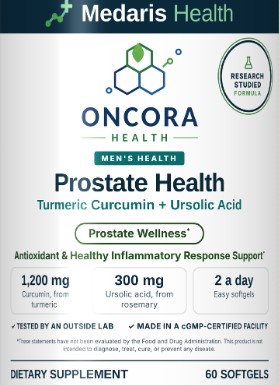
ONCORA Prostate Health is the product I wanted and couldn’t find:
- Curcumin 1,200 mg and ursolic acid 300 mg daily, matching the 4:1 ratio in the research.
- Two softgels a day, 60 per bottle, a full month’s supply.
- An oil-based softgel, so absorption doesn’t depend on what you ate for breakfast.
- Purity listed on the label, made in a cGMP-certified facility and checked by an independent lab.
ONCORA supports prostate wellness, antioxidant activity and a healthy inflammatory response.*
New pricing: less than half the cost of mixing your own
ONCORA’s suggested retail price at launch is $39.99 for a 30-day bottle.
I priced out my old kitchen-counter routine to compare. Matching the research amounts with the two leading Amazon’s Choice curcumin and ursolic acid products means buying three bottles of one and one bottle of the other each month: roughly $94 and 10 capsules a day. ONCORA gets you the same daily amounts in two softgels for less than half that.†
The savings are real, but they aren’t the main point. Separate products come in different forms, their purity varies by brand, and no one has tested them as a combination. Mixing your own means trusting a formula nobody has checked. Every ONCORA batch is made to the research amounts and tested.
What’s next for Medaris Health
Prostate health isn’t the only place this happens. Good research on natural combinations can sit unused for years, because ingredients that can’t be patented rarely attract the money needed to bring a product to market. Medaris Health exists to close that gap. Five more products are moving through the Medaris pipeline, and none launches until it clears the same bar as ONCORA:
- FULLORA for Men, supporting hair growth and thicker-looking hair*
- FULLORA for Women, supporting fuller-looking hair through menopause and beyond*
- STEADORA, supporting healthy blood sugar levels already in the normal range*
- SLUMBORA, drug-free, non-habit-forming support for restful sleep*
- BRIGHTORA, supporting clear-looking skin*
That bar is simple: published human research, the amounts that research used, purity printed on the bottle and outside lab testing. Every ingredient and amount goes on the label. No blends that hide the numbers.
When ONCORA is available
We expect ONCORA to launch in spring 2027, starting on Amazon. If you want word the day it goes on sale, sign up for launch updates at medarishealth.com.
A word from one patient to another: I’m not a doctor, and ONCORA is not a cancer treatment or a way to keep cancer from returning. Follow your doctor’s plan, go to every follow-up, and check with your doctor before adding any supplement. That’s exactly what I did, and still do.
About the author: Kip Lytel, CFA, started Medaris Health in Santa Barbara, California, to turn published supplement research into products people can actually buy. More at medarishealth.com.
¹ About 1 in 8 men: American Cancer Society, Key Statistics for Prostate Cancer. About 4 in 10 needing more treatment: Stabile et al., BJU International, 2019, 1,032 men treated with focal HIFU; freedom from any further treatment was 59% at five years.
² Lodi et al., “Combinatorial treatment with natural compounds in prostate cancer,” npj Precision Oncology, 2017, University of Texas at Austin. Cell and animal research only, not tested in people.
³ Phase 1 study of curcumin and ursolic acid in healthy men, 2024.
† Suggested retail price at launch; actual retail prices may vary. Comparison based on Amazon prices for the two leading Amazon’s Choice curcumin and ursolic acid products, checked November 16, 2026, before sales tax, at daily amounts of 1,200 mg curcumin and 300 mg ursolic acid, as used in the published university study.
*These statements have not been evaluated by the Food and Drug Administration. These products are not intended to diagnose, treat, cure or prevent any disease. The studies described tested the ingredients, not ONCORA. Talk to your doctor before starting any supplement, especially if you are in treatment or take prescription medicines.